
Symphony orchestras in Indonesia have a long and complex history shaped by shifting cultural ideologies, social hierarchies, and the political dynamics of Dutch colonial rule. Today, in 2026, orchestral music is more accessible than ever, with live performances available through live concerts, digital streaming platforms as well as traditional physical releases. Across Indonesia, major cities now host orchestras founded through a mix of initiatives—ranging from professional musicians and Western classical music enthusiasts to local governments and younger generations driven by curiosity and creative ambition. Audiences for symphonic music in Indonesia are equally diverse, extending well beyond elite circles to include listeners from a wide range of social and cultural backgrounds.
The development of symphony orchestra culture in the Indonesian archipelago has been marked as much by discontinuity as by growth, with many ensembles rising and falling since the 19th century. The earliest documented symphony orchestra during the Dutch colonial period dates to 1915, with the establishment of the Bataviaasch Staforkest (Batavia Military Corps Orchestra) which was strongly linked to the colonial Dutch East Indies military corps, the KNIL (Het Koninklijk Nederlandsch-Indisch Leger) under the direction of Dutch conductor Nico Gerharz (1872–1939).
Following the Indonesian War for Independence (1945–1949), Jakarta became the center of orchestral activity in the newly independent nation. Several ensembles emerged during this period and into the early decades of independence, including Orkes Radio Djakarta (1950), Orkes Studio Djakarta (circa 1950s), Cosmopolitan Orchestra (circa 1950s), and later the Jakarta Symphony Orchestra (1968), which continued into the New Order era (1966-1998). Together, these ensembles reflect both the persistence and fragility of orchestral institutions in Indonesia, shaped by broader political transitions and evolving cultural priorities.
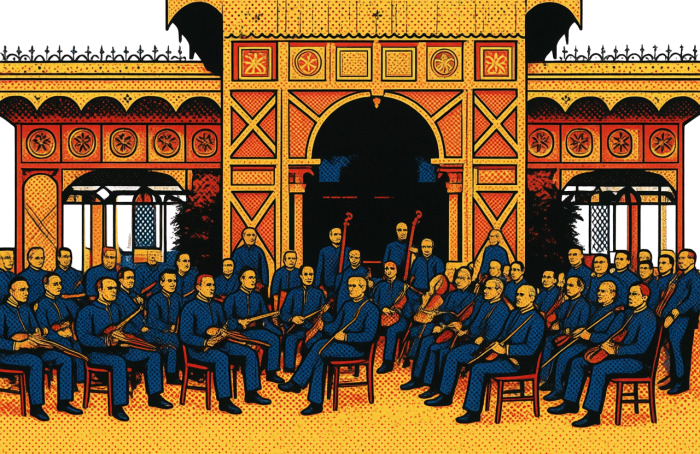
I invite you to take a closer look at the symphony orchestra scene during the Indonesian Revolutionary War period (Indonesian War for Independence). In 1948, one of the most significant and costly initiatives in Western classical music took place when a group of 65 musicians was brought from the Netherlands to Indonesia via Tanjung Priok harbour (north of Jakarta). This ensemble became known as the Radio Philharmonisch Orkest, led by conductor Yvon Baarspul with Herman van der Vegt serving as concertmaster. The orchestra’s role extended beyond radio broadcasts and public performances in Jakarta. It was also tasked with fostering musical education—supporting school and youth orchestras and helping to train young Indonesians as future music teachers.
The musicians, most of whom were men from the Netherlands, lived under notably comfortable conditions. They were accommodated at the prestigious Hotel Des Indes, located within walking distance of their workplace at the radio station. After a year of service, their families were permitted to join them in Jakarta, with a dedicated housing complex prepared for their stay. Rehearsals took place in a large studio known at the time as Radio Omroep in Overgangstijd (ROIO). The orchestra also received support at the highest levels, with Indonesian Vice President Mohammad Hatta serving as one of its patrons.
The orchestra’s premiere concert took place on August 30, 1948, at the Garden Hall of the Planten- en Dierentuin in Batavia (now Ragunan Wildlife Park, South Jakarta). This event marked not only the debut of the Radio Philharmonisch Orkest (RPO), but also commemorated the 50th anniversary of the reign of Queen Wilhelmina. The program featured works by Bach, Geraerdts, and Brahms, along with Het Wilhelmus, performed together with the Oratorium Choir before an audience of more than 1,000 people; all tickets were sold out.
Beyond its regular concerts and radio broadcasts, the orchestra undertook several tours. In September 1949, it traveled by ship to Semarang, Surabaya, and Bali. In November of the same year, the ensemble flew to Singapore, presenting five concerts at the Victoria Memorial Hall. Later, toward the end of 1949, it performed two concerts in Pladjoe, near Palembang.
Within the orchestra, smaller ensembles also emerged. Several musicians formed chamber groups, including two string quartets and a wind quintet. The wind quintet collaborated in performances with pianists Frans Szabo and Douda Poliakine. In addition, two sub-ensembles developed from the RPO: a chamber orchestra led by conductor Frits Hinze, and the Cosmopolitan Orchestra under Jos Cléber, which focused on lighter repertoire alongside standard symphonic works.
Public interest in orchestral music began to grow during this period. The management of Radio Omroep in Overgangstijd (ROIO), which oversaw the government-funded orchestra, sought to advance a broader cultural mission by broadcasting recordings widely across Indonesia, including in cities such as Semarang, Surabaya, Bandung, and Makassar. Alongside its core symphonic programming, the RPO also presented a dedicated series of seven concerts featuring Dutch composers.
At the end of its existence, the orchestra gave two farewell concerts in June 1950, performing Beethoven’s Ninth Symphony with a mixed Batavia choir. Shortly thereafter, on July 21, 1950, the musicians returned to the Netherlands. Some later came back to Jakarta to join a newly established ensemble, the Orkes Radio Jakarta, led by Henk te Strake, which continued its cultural activities until 1953.
Reflecting on the developments at the end of the Indonesian Revolutionary War raises an important and complex question: what was the underlying mission of the Kingdom of the Netherlands in “promoting culture” during this period? This question becomes particularly relevant when viewed alongside the establishment of the Radio Philharmonisch Orkest (RPO) in Jakarta in 1948 and the subsequent Round Table Conference held in The Hague a year later. Among its many outcomes, the conference outlined a framework for cultural cooperation between Indonesia and the Netherlands, emphasizing principles such as freedom, voluntariness, reciprocity, and the cultivation of independent thought.
However, these ideals were met with deep skepticism in Indonesia. After centuries of colonial rule, many Indonesians viewed cultural initiatives not as neutral exchanges, but as instruments historically used to sustain capitalist and imperial power structures. The introduction of Western cultural institutions such as symphony orchestras could therefore be interpreted as part of a broader attempt to maintain influence during a period of political transition.
Prominent Indonesian intellectuals and cultural figures, including Ali Sastroamidjojo, Muhammad Yamin, and Paku Buwono XII, voiced strong concerns about this cultural cooperation. Alongside figures such as Suharjo Kolopaking, Sim Kie Ay, S.P. Susuhunan, and Mangkunegoro VIII, they warned that culture could become a “final weapon” for the Netherlands a subtle yet powerful means of reasserting influence after formal political control had ended.
Their concerns point to a broader understanding of culture not merely as artistic expression, but as a domain with profound political and social consequences. In this view, cultural policy had the potential to shape public consciousness, influence education, and redefine national identity—making it, in some respects, even more impactful than direct political intervention.
That question cuts right to the heart of what “freedom” in music actually means. And the honest answer is: only partially. On one hand, musicians and audiences in Indonesia today are far freer than in the late colonial or early post-independence periods. There is no longer a state-imposed cultural agenda tied to a foreign power, and orchestras are now initiated by local communities, educators, and artists. Programming choices, collaborations, and educational efforts are increasingly shaped from within rather than dictated from outside. In that sense, there is genuine artistic agency.
But freedom in form and mindset is more complicated. Much of Western classical music still arrives with inherited conventions, concert etiquette, dress codes like tuxedos and bow ties, rigid stage hierarchies, and expectations of silence and “seriousness.” These are not neutral; they come from specific European historical contexts. When adopted uncritically, they create distance between the music and local audiences, making performances feel exclusive or ceremonial rather than alive and relevant.
So the real issue isn’t whether tuxedos or formal structures exist. It’s whether they are choices or constraints. If musicians consciously decide to keep certain traditions because they serve the music, that’s freedom. If they feel obligated to preserve them in order to be seen as “legitimate,” then the legacy of cultural hierarchy and colonialism lingers in a subtler form.
There are already signs of change. Some ensembles experiment with informal concerts, mixed genres, local repertoire, or new ways of engaging audiences. These shifts suggest that Indonesian musicians are not just inheriting Western classical music, they are reshaping it.
In the end, the deeper question might be: are we listening to the music as a living experience, or performing a ritual we believe must not be altered? Real freedom begins when that distinction becomes clear and when musicians and audiences feel empowered to redefine the experience on their own terms.
Independently researched and written by Alfian Emir Adytia.
Sources:
Sitorus, Eritha Rohana. 2009. Amir Pasaribu: Komponis, Pendidik & Perintis Musik Klasik Indonesia. Yogyakarta: Media Kreatifa.
http://iml.nederlandsmuziekinstituut.nl/
https://www.indonesienu.nl/2017/01/ragunan-oudste-dierentuin-van-indonesie.html
https://jakartaphilharmonic.org/history/
https://onh.nl/video/50-jarig-regeringsjubileum-van-koningin-wilhelmina-haarlem-1948


Leave a Reply